Popular Posts

Sunday, March 19, 2023


 Egypt Tour in January 2023

PART II

ALEXANDRIA AND CAIRO

Alexandria

On 23rd January Morning, after taking Breakfast at the Hotel in Cairo, I left for Alexandria trip.  The drive from Cairo to Alexandria takes about 3 Hrs and the distance is 280 kms.  The road was good and we reached around 11.15 am.    The city of Alexandria was originally established by Alexander the Great, the most famous Greek King and army leader, in 332 B.C.  

Ancient Alexandria was located to the west of the west branch of the Nile, near the ancient Egyptian village of Rakotis and the thin strip of land between the Mediterranean Sea and the lagoon of the vast area, which is now called Lake Mariut. The new city of Alexandria, in the 4th century BC was built by Deinokrates (was a Rhodian architect who served as technical advisor to Alexander the Great) and was featured for the fact that the Greek and the Pharaonic cultures lived side by side and even mingled together in some areas like the Catacombs of Kom El Shuqafa in particular.   

The city, nicknamed the Athens of Africa, greatly flourished during the Ptolemaic period, named after its founder Ptolemy I, who took control of Alexandria and many other cities after the death of Alexander the Great at the beginning of the 4th century B.C.   Alexandria retained its position and remained as the capital of Egypt until the death of Cleopatra VII. Shortly afterward the Romans took control of the city, and of Egypt in general, to add the country to their already large and expanding empire.   

The guide who accompanied was Mr. Jimmy and the first place to see was the Catacombs in Kom El Shoqafa of Alexandria.  The catacombs are essentially the burial site and here there were provisions for both burial and to keep urns after cremation too.  The various chambers allocated by their size indicate this.   Dating back to the 2nd century AD, this necropolis was dug inside the rock to a depth of 35 meters (115 feet).   It was found by chance in September 1900, when a donkey fell into the main hole of the cemetery, and while searching for the donkey, this was found.

It consists of three levels, all located under the ground level.  (It is said the area was affected by Tsunami in the year 365.  On July 21, 365, a powerful earthquake off the coast of Greece caused a tsunami that devastated the city of Alexandria, Egypt.)   A winding staircase leads to the catacombs and the tombs are arranged on three levels.   The vestibule leads to a circular hall called the "rotunda".  To the left of the rotunda is a vestibule which leads to a chamber. The chamber was also cut into the rock and its ceiling is supported by 4 pillars. It contains 3 benches, again cut in the rock, and takes the shape of the letter U. This chamber was called the "Triclinium".  2 composite columns, containing a mixture of Egyptian and Greco-Roman elements, support the façade of this hall.  The reliefs decorating its walls depict scenes from the myth of Osiris, god of the underworld. A mummified body is lying on an Egyptian funeral bed, which is guarded by Isis, the wife of Osiris, and his sister Nephthys. Other decorated chambers are located north of the rotunda.  The walls of the room have scenes representing the Roman Emperor wearing his crown and presenting his offerings to the goddess Isis, who is protecting the deceased with her wings.


God Anubis with a Human body


Immediately after entering the main compound of catacombs, there is a board explaining the layout of the catacombs and in the nearby open space, there is a Sun Dial too.  Both are shown here.


                                                             Pompey's Pillar


Afterwards, the next place to visit was the Pompey's Pillar, which is just a km away from the catacombs.  This is a column of monolithic pillar and is attributed by some to General Gaius Pompey who was involved in a civil war and a rival to Julius Caesar who was murdered by a Ptolemic Pharaoh in the year 48 BC, when he fled to Alexandria.  But the people at that time admired him for his help in overcoming famine.  Some other historians differ to this theory.  This column of around 100 Metres of Red Granite from Aswan was erected in a his burial site according to these Historians.  The Pillar also is of 2.7 metres breadth at its base.   Some other historian felt that the pillar was instead a triumphal monument erected around 300 AD for the Roman Emperor Diocletian, but the true significance of this archeological site is what stood here before the pillar.  However many feel this site owes its importance because it had a temple in this site for Serapis even before the Pillar was erected there.  The Serapeum, dedicated to Alexandria’s patron god, Serapis, was a symbol of this ancient tradition, which conflicted with the increasingly popular ideas of Christianity.   In 391 AD, patriarch Theophilus, leader of the Church of Alexandria, led a Christian mob to destroy the Serapeum and other symbols of paganism in the city. Some accounts even blame this mob for the destruction of the Great Library of Alexandria, although this is disputed.   A life-size black basalt bull from the temple, Apis and a golden plaque marking the foundation of the Serapis are on display in the Greco-Roman Museum.   
Apart from a Pillar with lions on both side of Pillar, a lot of destruction could be seen here.   Also an underground tunnel type ways are found here, which is attributed to the temple of Serapis.
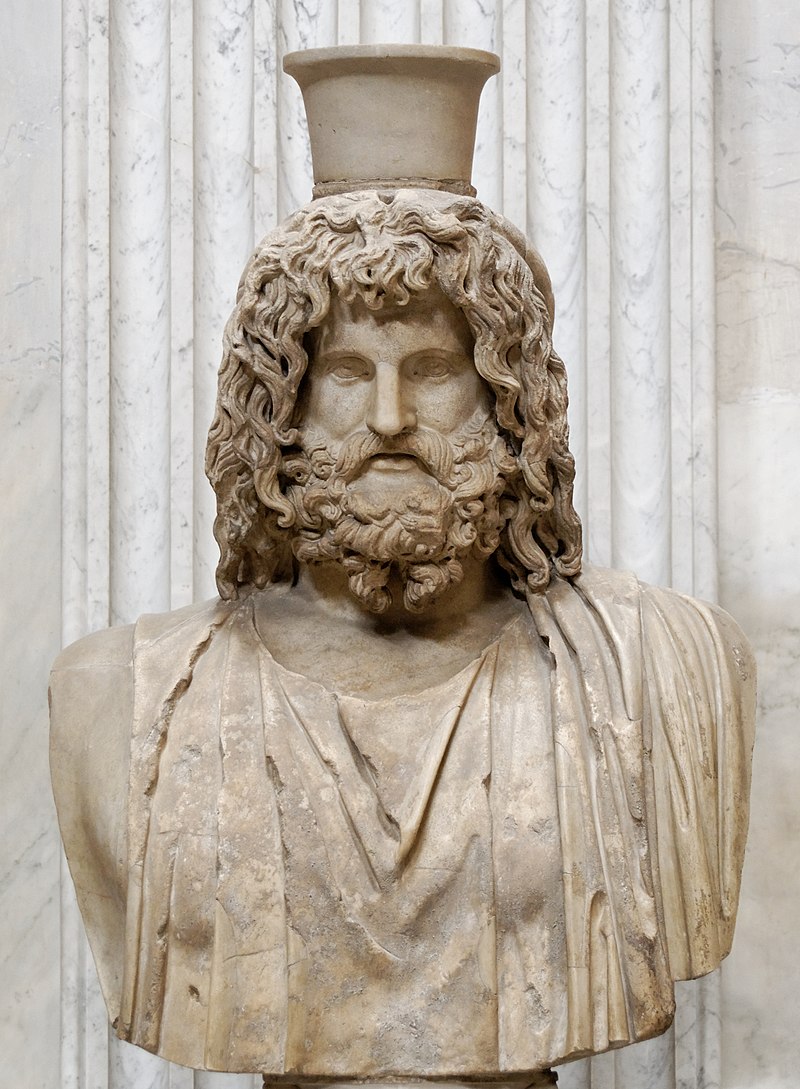
                                                                   SERAPIS


Photos taken in Serapium


Standing at Apis Bull, Serapium

Serapium  is dedicated to the god Serapis, a syncretic god combining aspects of Osiris and Apis, and was popular among the Hellenized Egyptians of Alexandria.   From here, I went to the Roman theatre nearby.


The place is also known as Kom El-Dikka.  Kom el-Dikka, which literally means a 'pile of rubble,' was a slum until 1959 when a team of Poles excavated the site in search of the tomb of Alexander the Great.  When the workers went to remove a pile of dust and sand in 1960 to clear the land for the construction of a governmental building, they found some solid iron columns, indicating that something may be buried underneath.  Immediately afterward, the excavation work began in the location of Kom El Dikka and it was carried out by the Greco Roman Museum and the Polish Excavation Mission in Egypt sponsored by the University of Warsaw.  The excavation led to the amphitheatre of Roman Period and is preserved today as a monument.

It was lunch time, when I completed the rounds around this part of Alexandria and thus I had my Vegetarian lunch (Ordered earlier by my guide) at Athenios Restaurant along the beach road.  The surprise element was the dish named as Indian Vegetable and it was a wonderful Sambar with all vegetables.  (later on different places served this Indian vegetable but not like this).   I was given a nice table with the seashore view and took a few photographs from within the restaurant as well as from the Beach road.


Library, Alexandria


After Lunch, we headed towards the new Library at Alexandria but only had the opportunity to see from outside as the time was nearing 4 pm and the guide wanted to return to Cairo at least by 7 pm, so as to have dinner and rest for the next day programme at Cairo.

CAIRO

The plan was to start after the breakfast and around 8 am on 24th Jan 2023, and we started as per Plan but this day, it was very foggy.  Though we had reached Giza pyramids area by 8.45 am, the weather was such that only 9.30 am Sun came out.  There is a ticket to see things around Giza and a separate ticket for entering into the main pyramid in Giza.  The main Pyramid in Giza is the tomb of the King and Queen Khufu of the 4th Dynasty.   The other two pyramids are for his son and grandson and are known by their name as - Khafru and Menkaure. The three pyramids are of height 145, 136 and 66 Metres respectively.   The steps to ascend within the pyramid for the initial distance is to crawl holding the rails provided on either side and the last 1/3 rd of the distance you can walk upright, to reach the chamber of the tomb of King Khufu and his wife.   The upper chamber is around 15 ft by 15 ft.  Photography is allowed throughout the area.   Camelwallahs are ready to take you around for a fee and also provide you with the headgear for purpose of photos.   

                                                Tomb of King Khufu and the Queen


The guide Mr. Jimmy was the reason for myself not giving up in the middle as he encouraged me that I can do by completing all the steps and finally entering the chamber the where tomb was.  A few more photographs as a collage.


Helipad made to help Mr. Obama former POTUS


The sphinx is at a distance of around 1.5 kms within the Pyramids complex of Giza and the ticket for the area includes this too.   This is the reverse of the Egyptian ancient gods with body of man and animal face and Sphinx has the face of a man and body of a Lion.   Most scholars date the Great Sphinx to the 4th dynasty and affix ownership to Khafre. However, some believe that it was built by Khafre's elder brother Redjedef (Djedefre) to commemorate their father, Khufu, whose pyramid at Giza is known as the Great Pyramid.  In Egyptian myth, the Sphinx was more of a symbol than an individual entity. It was a guardian figure, the protector of the pyramids, and the scourge of the enemies of Re, the sun god. It also represented the pharaoh and the pharaoh's divine power.  it has been carved out of a single stone.  In 1378 CE, Egyptian peasants made offerings to the Great Sphinx in the hope of controlling the flood cycle, which would result in a successful harvest. Outraged by this blatant show of devotion, Sa'im al-Dahr destroyed the nose and was later executed for vandalism.

yrus sh
The time taken to go around Pyramids and Sphinx was about 4 1/2 hours and we left for going round the Cairo city.   In this period, I was taken to the so called Papyrus Institute of Egypt, Cairo Museum, Khalil Bazaar (Roadside selling with bargain) and finally I was taken to the Cairo Railway Station to board the train to Aswan.  

Papyrus, Egypt
It is a speciality to Egypt and ancient Egyptian had the knowledge to make wonderful paintings on Papyrus Sheets, which would last for many centuries and this they were following from the BC era.  The place where I was taken to, had the facilities to show how a Papyrus Sheet is being prepared and also how drawings are made on them.  Stems of Papyrus plants are cut and taken to the press, to drive out the water and to get completely dry and the long strips of these are arranged to overlap with one another to make a sheet.  The place also sells the Paintings.  Bargaining is very common here.  Painting of Isis with Nephtees, her sister.


                                                              Papyrus Plant


Perfumes
Adjacent to the Papyrus sale shop is the Perfume Shop and they sell again with bargain.
They were telling me, they have their own farm for the flowers and the perfumes have been made from the flowers and genuine.  The quality of the perfume was good as told by my family.

Museum, Cairo.


This is one place, one cannot miss to go with complete information available on  dynasties from the various artefacts taken out during excavations.  Photographs are allowed and we can spend at least 2 hours here.  The exhibits have been arranged both in Ground and First floor.  In addition to 38 items “found or acquired” by Howard Carter of Tutankhamun fame, it holds more than 45,000 other artifacts from ancient Egypt — of which fewer than 2,000 are on display. Spaces have been provided for the future excavation findings for some of the dynasties for which information is so for not available.  A few photographs from the Museum is arranged as a collage and given here.

Narmer Palette showing Narmer with Lower Egypt crown with Papyrus on crown, it has another side at the rear not shown here, and to it right is Pharoahs and then is the High Priest Rehotep with hand in his chest with his wife Nofret and a veiw of the central hall of the Museum in the first row.  The second row has the treasures of Tutankamen, Drawings on Stone, Seated Scribe from a tomb in Saqqara, Wooden Statue of Sheik el-beled- Chief lector Priest and Hieroglyphs.   The third row has a mummification pit with all the inscriptions, Detail from Narmer Palette with Narmer shown as bull and killing a foe, the golden shield of Mummy of Tutankamen inlaid with precious stones and board in Musueum asking not to take photographs of the valuables which were kept in the room along with mummy of Tutankamen.


Rear side of the Tutankhamun Shield


From the Museum, we went to Khalil Bazaar and I purchased some souvenirs here on the roadside bazaar.  


A few photographs of Cairo taken from the cab, as I proceeded to various tourist sites and in a collage.


Had some French fries from eatery around Khalil Bazaar and proceeded to Cairo Railway Station and reached there at 07.30 pm and the train to Aswan arrived at 8.10 pm.


It is a complete AC coach train and night dinner and morning breakfast were served and reached Aswan, next morning at 09.30 am, that is on 25th January.   


Egypt Tour in January 2023

PART III

ASWAN AND ABU SIMBEL

As I reached Aswan, Travco agent met me in the Station and introduced to the guide Mr. Hany and informed that he would be available for the next two days for in and around Aswan.   Immediately after coming out of the railway station, to the left I could see the Aswan Market.  With the luggage in the vehicle, the tour of Aswan started and the plan was to board the Cruise Boat JAZ Crown Jewel, after visiting Aswan High Dam and Philae temple.

From the railway station, we travelled around 8 km to reach the new dam on the upper stream built between the Years 1960-64 on the Nile River.  This also enabled to have a very big lake named Nasser lake also called Lake Nubia, in Upper Egypt and northern Sudan.  The process was to block half the river and allowing the water to flow to a lake and then closing it also.  The earlier dam which was there was only useful for storage of water.  The new one was made as a Hydro-Electric project and thus enabled for Power Generation.  The storage capacity was increased too.

 The Aswan High Dam is 3,830 metres long, 980 metres wide at the base, 40 metres wide at the crest (the top) and 111 metres in height.    The Aswan High Dam was built in the 1960s and dedicated in 1971. The High dam thus spared the farmers from seasonal droughts and flooding, and generated electricity, spurring Egypt's rapid development.   With a reservoir capacity of 132km³, the Aswan High Dam provides water for around 33,600km² of irrigation land. It serves the irrigation needs of both Egypt and Sudan.  Egypt and Sudan reached an agreement in 1959 that saw the allocation of 18.5 cubic kilometres of water to Sudan.    The dam also improved navigation across the Nile, benefiting the tourism and fishing industries. Water from the dam is used to feed 12 power turbines, which provides half of Egypt’s power demands.   

Besides, Nasser lake, man-made along with the construction of High Dam has increased the amount of arable land and crop production in Egypt.  The creation of the lake threatened to submerge a number of significant historical sites— notably the tombs and temples at Philae and Abu Simbel—under its waters. The Egyptian government appealed to UNESCO, with whose assistance many monuments were dismantled and reconstructed on safer ground.  A lot of Nubians were resettled in other parts of Aswan, who were earlier living along the Nile, after the construction of High Dam and also formation of the big reservoir Nasser Lake.

                                                                      Aswan Old (Low) Dam


                                                                     ASWAN HIGH DAM


NASSER LAKE


Philae Temple, Aswan
After the High Dam tour, we went to the boat jetty and crossed the Nile river to see the Philae Temple.   As described already, the temple had to be shifted after the water was led into the new Nasser lake while constructing the High Dam.  Philae Temple was relocated in 1971 to higher ground on Agilkia Island.  There are iron rod markings made to easily reassemble at the new site.  Built during the reign of Ptolemy II (Egypt's Greco-Roman Period), the Temple of Isis at Philae is dedicated to Isis, Osiris, and Horus. The temple walls contain scenes from Egyptian mythology of Isis bringing Osiris back to life - with key of life, giving birth to Horus, and mummifying Osiris after his death.  She was worshipped both by Egyptians and Nubians.  


 The monuments of Philae cover four major epochs: the last part of the Pharaonic era, the Ptolemaic period, the Roman epoch and the Christian period. The chief monuments are the Temple of Isis (1) and her son Horus (Harendotus) (2), the beautiful Arch of Hadrian (3), the Temple of Hathor (4) and the Kiosk (5), which is also known as Pharaoh's Bed.

On the front of the east tower, a huge relief depicts Ptolemy XII Neos Dionysos (Father of Cleopatra VII) grasping a band of enemies by the hair and raising his club to smite them, with Isis, the falcon-headed Horus, and Hathor on the left.   Above are two reliefs of Neos Dionysos presenting the crowns of Upper and Lower Egypt to Horus and Nephthys (right) and offering incense to Isis and Harpocrates (left).  Harpocrates was the god of silence in the Hellenistic religion, adapted by the Greeks from the god Horus, who in Egypt represented the rising sun.


The central courtyard is made up of row of columns and to the west of it is the Birth House where Horus was born to Isis.  The Second Pylon provides a fittingly regal entry to the inner sanctum of the temple, with a magnificent doorway 32 meters wide and 12 meters high.


The eight-columned Vestibule is the first room of the inner temple area and was originally separated from the court by screens between the columns on the front.   
Here are Coptic crosses and Greek inscription incised into the walls that show how the temple was transformed into a Christian place of worship during the early Byzantine age under the Coptic Bishop Theodore.


Further, when you proceed inside is the Isis temple.  After passing through a number of antechambers flanked by dark side chambers, you come to the Sanctuary, lit by two small windows.  The granite base here (presented by Euergetes I, also was Ptolemy III and his wife Berenice) would have held the sacred barque bearing the image of Isis.


To the left of the first antechamber is a small room with reliefs of the king in the presence of Isis. On the west side of this room is a door leading out of the temple to arrive at the Gateway of Hadrian.

Among other things, it bears the abaton decree with regulations concerning the cult of Osiris on Biga and a text recording the donation of a vineyard to the Temple of Isis. There are various scenes involving Osiris, as well as other gods and the Roman Emperor Hadrian. In the vestibule that proceeds the gate there is an image of the Nile god entwined by a serpent and pouring water from two jars, symbolizing the birth of the Nile River. To the north of the gate are the remains of the Temple of Harendotes (a form of Horus).


Just 50 meters east of the Temple of Isis is the little Temple of Hathor, built by Philometor (Ptolemy VI) and Euergetes II (Ptolemy VIII) in honour of Hathor-Aphrodite.


Southeast of the Temple of Hathor, on the banks of the river, is the Kiosk of Trajan, with its impressive columns.   The unfinished monument is attributed to Trajan, Roman emperor from 98 to 117 AD, due to his depiction as pharaoh seen on some of the interior reliefs.  The kiosk has 14 massive columns with carved floral capitals. The capitals of the plant columns were intended to be surmounted by sistrum (a percussion instrument that become a representative cult object of Hathor) capitals.   Inside are reliefs showing Trajan as a pharaoh making offerings to Osiris, Isis and Horus. 


There is light and sound show too available at Philae temple with vehicle pick up arrangement.

Unfinished Obelisk

Egyptian kings liked to have obelisks made and dedicated to themselves by carving their names and religious dedications onto the four sides of the obelisk’s shaft.    They are found throughout Egypt and usually stand in towering pairs in front of entrances to temples. Known in ancient Egyptian language as tekhen, they are made from a single piece of stone with a rectangular shaft and topped by a gilded pyramidion to reflect the sun’s rays. 

The unfinished obelisk site is at a distance of 3 Kms from the Aswan Railway Station.  
Believed to have been commissioned by Hatshepsut (c. 1473–1458 BC) for the temple of Amun in Karnak, work was abandoned because of flaws in the stone and the presence of multiple fissures.  Three sides of the enormous shaft were completed when the masons discovered a crack in the granite and abandoned it, still half attached to the bedrock it was being carved from.   


Soon after this, I returned to where cruise JAZ Jewel King was stationed, boarded and occupied the cabin allotted and had my lunch.  (The last part of the posting is about the boat). The evening was free and there was no programme.   The cruise also was to start only in the afternoon of the next day i.e. 25th Jan. 

A few snaps taken in the Railway station inside and outside and in the City is shown below in a collage.


Abu Simbel

It was planned for an early start from Aswan to proceed to Abu Simbel at 4 am in the morning.  The cruise boat kitchen made ready the breakfast and packed and gave it to be carried in a bag.  Also, they served coffee at that time.   However, all vehicles will have to stop at the check post and clearance to proceed to Abu Simbel is normally given from 5 am only.  It takes hardly half an hour to proceed to the check post from any part of Aswan and hence all vehicles wait at check post to form a queue and to leave at 5 to 5.15 am depending where your vehicle is in the queue.    The drive to Abu Simbel takes around 3 hours and thus we reached around 8.45 am with a break of 10 minutes on the way.

Lot of new Canal works have been taken up recently which I could see on the way and also farming is being done in these areas.  I learnt a lot of new areas are being brought into cultivation with Wheat and Sugar being the most that are cultivated.  The vastness of Nasser Lake is seen to be believed at Abu Simbel.  This temple which would have submerged in waters of Nasser Lake was rebuilt in the adjacent ground a Km away with the help of UNESCO and was declared a heritage site.  Iron rod markings were made before dismantling to be assembled later at the new site. The Abu Simbel Temples were dismantled and relocated in 1968 on the desert plateau 64 meters above and 180 meters west of their original site.

Abu Simbel temple is dedicated to the worship of Ramses II himself and the great deities of ancient Egypt, Amon, Ra, and Ptah.  Abu Simbel is a village in the ancient Upper Egyptian region of Nubia, are dedicated to sun gods, 13th century Pharaoh Ramesses II and his first wife Nefertari and a temple is dedicated to the Goddess Hathor.  The Abu Simbel Sun Festival is a bi-annual event that takes place at the spectacular temple of Ramses II in the south of Egypt. On two days of the year the central chamber of the temple is illuminated by the sun. 

The entrance to the Great Temple is flanked by four colossal statues on its facade, 20 metre statues, each one representing Rameses II seated on a throne. The façade of the main temple is decorated with hieroglyphs that commemorate the great victory of Ramses II at the Battle of Kadesh.  Ramses built the Temple at Abu Simbel in Egypt to intimidate his enemies and seat himself amongst the gods.  Inscriptions within the temple indicates there was a sculptor by name Pyay, who was entrusted with the work of construction of the temple.  The monumental work had to be carried out with the help of multitude of workmen.   It appears a lot of painting also would have been used at that time.  Most of the wall pictures had been for bringing out the military glory of Ramses II, with the various phases of the battle of Kadesh.   The long epic poem written by Ramses II court poet Pentaur is engraved in hieroglyphs on the walls of this temple as well as that of Luxor and Karnak.

The Abu Simbel Temple is actually two individual temples, both rock cut structures, and both built during the reign of King Ramses II, 19th Dynasty Pharaoh, sometime in the 1200 B.C. time period. One temple is dedicated to King Ramses II, and the second temple is dedicated to his beloved wife Queen Nefertari.    Allegedly, the Swiss explorer Burckhardt was led to the site by a boy named Abu Simbel in 1813 CE and the site was then named after him.  The Pharaoh is shown wearing the Pshent, or Double Crown of Upper and Lower Egypt. The head of the second statue from the left is broken off and laying on the ground in front of the statue. This happened during an earthquake just after the temple was completed.   The height of the statues are around 10 Metres and huge and can be seen from a distance and the temple looks so beautiful on the banks of the Nasser lake.


After a little bit of purchase of souvenirs at Abu Simbel, the return journey to Aswan commenced and on reaching Aswan bought some herbal medicines and I retuned to the cruise boat stationed at Aswan around 2 pm and was in time for the Lunch.  


The cruise was to start at 14.30 hours from Aswan but started a little late and proceeded to Kom Ombo and the same has been posted in Part IV.